Coffee, Conversation and Calls: Meet Ladder 574’s C Shift
Published on April 13, 2023
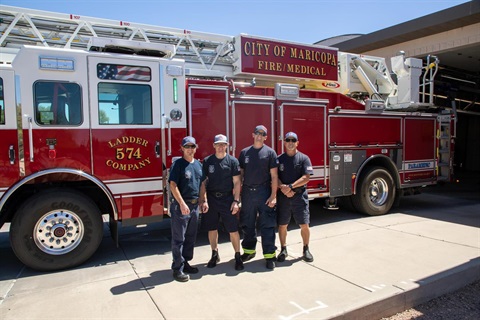
Coffee, Conversation and Calls: Meet Ladder 574’s C Shift
Written by: Monica Williams
Public Information Officer for Police, Fire & Emergency Management
I arrived at Firehouse 574 and was instantly greeted by the warm hellos of John Campanaro. He’s Ladder 574’s newest member after recently being promoted to the rank of Engineer.
We made a round through the firehouse greeting the rest of the crew before deciding we all could use a cup of coffee as we gathered at the dining table - a place that Captain Chip Wright later explains is a place they make sure to sit together each night for a family-style dinner.
I was there to interview Ladder 574’s four-person crew for an employee spotlight article. The pot of coffee was just set to brew when the tones sounded. On the far wall, a LED display lit up in red with the ladders' call sign, “L574”, and the call was read out across the loudspeakers.
This is where I got my first glimpse at the adaptability of our highly trained firefighters in action. At that moment, each of the four members of Ladder 574, Engineer Campanero and Captain Wright along with Firefighters Benjamin Foster and Roland Pfetsch, swiftly refocused their mindset to the emergency they were now headed to.
In their world, seconds mean life or death; coffee would have to wait.
The following questions were answered by the crew when we returned to the station about an hour or so later and we finally were able to enjoy a cup of coffee.
Question: What made you want to pursue a career as a firefighter here in Maricopa?
Answer:
I previously worked in a retirement community where you run the same five calls. The City of Maricopa presented something new and I liked the fact that I would be in a growing city. They accepted me for some crazy reason.
- Engineer Campanaro
In 2005, Maricopa was a start-up department. So my journey here was out of natural curiosity. You know, what’s going on down there?
- Captain Wright
The growth is exciting! Just the potential there is in this Department as the city continues to grow. We're the right size to get to know everyone and make easy connections.
- Firefighter Pfetsch
Question: What does a typical shift look like?
Answer:
Our shift starts at 8:00 a.m., but oftentimes we’re here before having coffee with the crew that’s coming off shift, cutting it up a bit. I try to make sure my crew always comes together for a 9 or 9:30 a.m. meeting once checks are done and we kind of plan our day. And you know, what's going on the next couple of days? What are we scheduled for? What do you guys need to do? And what kind of training we're going to get involved with, I try to plan it out as much as possible.
Monday through Friday, we stick to a work week where we're busy doing things and learning. Then after five o'clock, and on weekends, if there's nothing scheduled and we get our duties done then we kind of have a little bit more of our own time. We kind of just take it as it comes. You have to be adaptable because a call can come in at any moment for any type of emergency.
We also make sure we take time to check in with one another as we all have lives outside of the station and we’re coming in after four days off. A lot can happen during that time. We make sure we have dinner together that we all help buy ingredients for and prepare as a crew. Bonding together as a family is a very important part of this job because we have to trust each other with our lives.
– Captain Wright
Question: What is your relationship with your crew like?
Answer:
There's a mix of personalities in our department. It's not only just individual personnel but also shifts and crews who have their own traits. Some are a little bit messier than others. Some are a little bit louder than others. The commonality is that when the alarm goes off, we have something to do and all that stuff is set aside.
One of the things they don't talk about when signing up to be a firefighter is your quality of life after you leave the job. All of the things we see and interact with, I mean, that all bubbles up and boils over at some point. So the support system, while we're here, is one of the many things that we try to promote and reinforce daily. The Department is fantastic about promoting our mental health.
- Firefighter Foster
Question: How have you grown professionally while a part of Maricopa Fire/Medical?
Answer:
I am in a growth phase right now. I have walked away from a 21-year career in the backseat and moved forward in the twilight of my career, which is very uncomfortable. That's where you test your courage and yourself. I could have just said, no, I'm just going to see it through in the backseat. However, I wanted to challenge myself, because I was getting into a rut, doing the same thing. I know what I needed to do in the backseat and now I move forward, I don’t have a clue. So I'm leaning on these guys, the best part of the dynamic, that this is a team. We support each other to succeed.
- Engineer Campanaro
I was hired before I had a wife and kids. You have to be able to juggle this job with family because you're missing a third of their lives. You've got to still be able to come home and be a good husband and a good father. You’re dealing with the things that you may or may not have seen at work. If you get into those ruts, it's important to get out of them.
- Captain Wright
Question: What’s the best advice you can give to someone who just started their career?
Answer:
When we go on calls, there's a mindset we need to be in from the start. Then when we go and have station life, it's a different mindset. Being able to adjust between those two frames of mind alongside your crew is very crucial. You have a positive attitude, a willingness to learn, and a willingness to accept feedback in a positive way. You have to realize that this job can be really draining both physically and emotionally. There are times that you can be up four times in a night and you still have to be able to perform because once those tones go off, it’s time to act. You’ve sworn to protect these community members, regardless if you’ve only had three hours of sleep the night before. If you’re considering becoming a firefighter, you have to prepare for these situations before submitting your application.
- Firefighter Pfetsch